Disclosure: Some links in this post are affiliate links. BranchNova may earn a commission at no extra cost to you.
Introduction
AI improves margins in service businesses by reducing repetitive work, but many business owners still assume increasing profit means raising prices or finding more clients.
In reality, the largest opportunity often sits inside the work happening after the sale.
Every proposal, onboarding call, project update, client email, report, meeting summary, and internal handoff consumes time. Individually these tasks seem small, but together they create operational overhead that steadily reduces profit margins.
Artificial intelligence helps service businesses improve margins by shortening delivery times, improving resource utilization, and allowing teams to serve more clients without hiring proportionally more staff.
The goal is not replacing expertise. It is eliminating the administrative work surrounding that expertise.
Why Service Businesses Lose Margin as They Grow
Many founders expect higher revenue to automatically produce higher profits.
Instead, growth often introduces:
- more meetings
- more project management
- more revisions
- more documentation
- more client communication
- more administrative coordination
As each client adds operational complexity, labor costs rise faster than revenue.
This creates a common scaling problem:
Revenue grows.
Profit does not.
The Four Biggest Margin Leaks AI Can Reduce
1. Administrative Work
Consultants…
Agencies…
Marketing firms…
Accounting practices…
Legal services…
often spend hours every week on tasks that clients never directly pay for.
Examples include:
- meeting summaries
- scheduling
- proposal drafting
- documentation
- CRM updates
- follow-up emails
Automating these activities returns billable hours back to the team.
2. Slow Client Onboarding
Every delayed onboarding extends the time before work begins.
AI can help generate:
- onboarding checklists
- kickoff documents
- project briefs
- questionnaires
- implementation plans
Instead of building everything manually.
3. Knowledge Retrieval
Experienced employees often answer the same questions repeatedly.
Examples:
“Where is the onboarding SOP?”
“Which pricing template do we use?”
“What happened during the last client meeting?”
An internal AI knowledge system dramatically reduces time spent searching for information.
4. Reporting
Monthly reports often require hours of manual work.
AI can assemble:
- performance summaries
- executive updates
- campaign analysis
- client-ready explanations
allowing specialists to focus on interpretation rather than formatting.
A Practical Example
Imagine a seven-person digital marketing agency.
Without AI:
- account managers spend several hours weekly writing recap emails
- proposals are built from scratch
- onboarding requires multiple meetings
- reports are manually assembled
As the agency grows from 20 to 40 clients, overhead expands almost as quickly as revenue.
Now introduce AI into the workflow:
- meeting notes become automatic
- proposal drafts are generated from templates
- onboarding documents are pre-filled
- recurring reports are drafted automatically
- internal documentation becomes searchable
The agency still delivers the same expertise, but the operational effort surrounding that expertise decreases.
The result is improved utilization, faster delivery, and healthier margins.
What AI Does Not Improve
AI cannot compensate for:
- poor pricing
- unclear positioning
- weak service quality
- inconsistent sales
- bad management
Businesses with broken processes often automate inefficiency instead of solving it.
Before introducing AI, standardize how work is completed.
Automation performs best when it supports a stable process.
Where Most Businesses Start Wrong
Many companies purchase multiple AI tools hoping productivity will improve automatically.
Instead they create disconnected workflows.
A better approach is:
- Identify repetitive work.
- Standardize the process.
- Document the workflow.
- Automate only stable steps.
- Measure time saved.
This incremental approach typically delivers better long-term results than attempting to automate everything at once.
Not sure which AI tools are actually worth using? Explore our Top 10 AI Productivity Tools guide to discover the platforms entrepreneurs and growing teams use to automate repetitive work, streamline operations, and build more efficient AI-powered workflows.
Building an AI Operating System
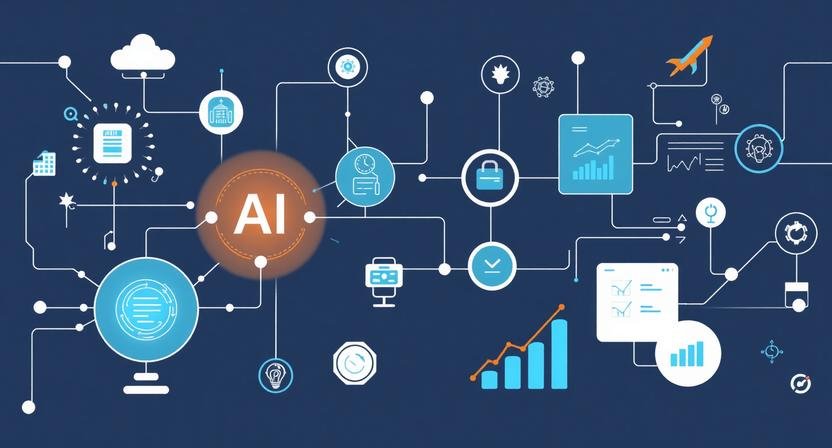
The highest-performing service businesses rarely rely on a single AI application.
Instead, they build connected systems where information flows between documentation, project management, communication, and reporting.
For example, a project created in ClickUp can automatically trigger task assignments, generate project briefs, store documentation, and keep the team aligned from kickoff through delivery. As operations become more standardized, this reduces manual coordination and helps teams serve more clients without increasing administrative overhead.
Key Takeaways
AI improves service business margins by reducing operational overhead rather than replacing professional expertise.
The biggest gains usually come from automating repetitive administrative work, accelerating onboarding, improving knowledge access, and reducing the time spent preparing recurring client deliverables.
Businesses that focus on fixing workflows before automating them are more likely to see sustainable improvements in profitability.
BranchNova Summary
Service businesses don’t usually lose margin because employees lack expertise. They lose margin because skilled professionals spend too much time on work that doesn’t create direct client value. AI helps recover those hours, allowing teams to deliver more work with the same resources and making growth more profitable.
Discover More Insights
About the Founder
Learn more about our founder, Esa Wroth, and his mission to make AI practical, human-centered, and accessible for entrepreneurs, creators, and professionals.